150 Zentangle Borders Pages Bundle -KDP
First Impressions: Delicate, Doodle-Driven, and Surprisingly Versatile
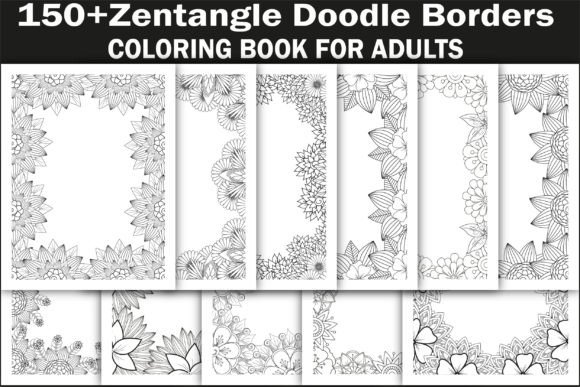
As a designer who’s stitched everything from monogrammed baby onesies to boutique aprons for small kitchen shops, I opened the 150 Zentangle Borders Pages Bundle -KDP expecting pretty coloring pages—and got something far more useful. These aren’t just floral doodles; they’re rhythmically balanced, hand-drawn borders built around leaves, vines, and organic geometry. The lines are confident but not rigid—soft enough for embroidery translation, detailed enough to hold visual interest at 3–4 inches wide. They feel like quiet luxury: think linen tea towels for a wedding favor, or the inner hem of an embroidered denim jacket—not loud, but deeply intentional.
A Real Embroidery Test: That Tote Bag You’ve Been Sketching
Last week, I used one of the simpler border designs (Page #47—a looping ivy-and-dot motif) on a natural canvas tote for a local florist’s gift set. I digitized it as a machine embroidery design with light fill stitch in the leaf centers and clean satin stitch outlines. It stitched cleanly on medium-weight cotton with tear-away + cut-away stabilizer combo. Customers noticed it immediately—not because it shouted, but because it *breathed*. The zentangle flow guided the eye smoothly around the bag’s side seam, and the hand-drawn imperfection translated into warmth, not wobble. That’s the quiet strength of the 150 Zentangle Borders Pages Bundle -KDP: it doesn’t fight fabric—it partners with it.
Where It Shines (and Where It Needs Thought)
This bundle works beautifully for:
- Custom apparel—especially sweatshirt cuffs, pocket edges, and collar bands where subtle texture adds polish without bulk;
- Baby embroidery—gentle botanical borders on burp cloths or blanket corners read as soothing, not fussy;
- Embroidered patches—many pages scale down cleanly to 2.5"–3.5" hoops, making them ideal for sew-on or iron-on applique designs;
- Holiday embroidery—use Page #89 (a wreath-style border) on linen napkins or ornament pouches—no seasonal clichés, just grounded elegance;
- Small shop product branding—stitch a narrow border along the tagline on a handmade soap label or ceramic coaster sleeve for instant cohesion.
Use With Care On…
Not every page is hoop-ready out of the gate. Here’s what I watched for:
- Small hoop sizes (under 3"): Some borders pack fine linework near corners—test stitch density first. Overly tight fill stitch can blur delicate zentangle dots.
- Textured or stretchy fabric: A heavy linen or ribbed knit can swallow fine line work. Opt for bolder, sparser pages (like #12 or #131) and reinforce with mesh stabilizer.
- Dark fabric: These are line-art graphics—no built-in contrast. Always test thread colors against your base. Navy + ecru reads calmer than black + white on charcoal.
- Curved surfaces (caps, curved pillow covers): Avoid borders with dense corner clusters—they’ll pucker. Choose flowing, open-loop patterns instead.
- Frequent-wash items (kitchen towels, baby bibs): Skip ultra-thin connecting lines. Prioritize pages where motifs repeat with breathing room—less stress on stitches over time.
What It Adds to Your Finished Product—Beyond Pretty
The 150 Zentangle Borders Pages Bundle -KDP quietly lifts perceived value. A plain cotton pillow cover becomes a curated bedroom accent. A generic sweatshirt gains signature craftsmanship. That matters—especially for Etsy sellers and craft fair vendors competing on authenticity, not just price. Buyers respond to intentionality: they see the hand-drawn origin, the balance of negative space, the way a border frames rather than overwhelms. It builds trust in your handmade product without needing a logo or tagline. And for digital product sellers? These are strong design assets—ideal for printable mockups, KDP interior accents, or layered POD templates where visual harmony is non-negotiable.
Practical Notes Every Embroidery Designer Should Check
Before cutting fabric or uploading to your embroidery software:
- Test on scrap fabric—same weight, same color, same stabilizer you’ll use in production.
- Check thread color contrast in natural light. What reads well on screen may vanish on oat-colored linen.
- Review stitch density, especially in tight corners or overlapping leaves. Adjust underlay or reduce fill % if needed.
- Confirm hoop size compatibility. Many pages fit standard 4"x4", but some wider borders need 5"x7". Measure before digitizing.
- Inspect small details at actual stitch size—dots, cross-hatching, and tiny spirals must translate clearly.
- Test in black and white mockups to gauge silhouette strength and readability.
- Compare light vs. dark backgrounds—some borders rely on line weight alone; others need tonal contrast to land.
- Use proper stabilizer: lightweight cut-away for stable fabrics, mesh or tear-away for knits.
- Verify licensing before selling finished items or bundling digitally—this is a Coloring Pages / Graphics product, so commercial embroidery rights depend on the creator’s terms.
Final Thought: A Quiet Tool for Confident Making
The 150 Zentangle Borders Pages Bundle -KDP isn’t flashy—but then, neither is the perfectly balanced hem on a custom apron, or the subtle vine border on a baby’s quilt that makes grandparents pause and trace it with their finger. It’s a collection that trusts your judgment as a maker. It gives you structure without rigidity, detail without clutter, and botanical charm without cliché. Whether you’re stitching for a client, building your craft business, or designing your next Etsy listing, these borders don’t distract—they deepen. And in embroidery, that’s where real connection begins.