Bold Easy Food and Snacks Coloring Book
First Impressions: Playful, Clean, and Surprisingly Stitch-Ready
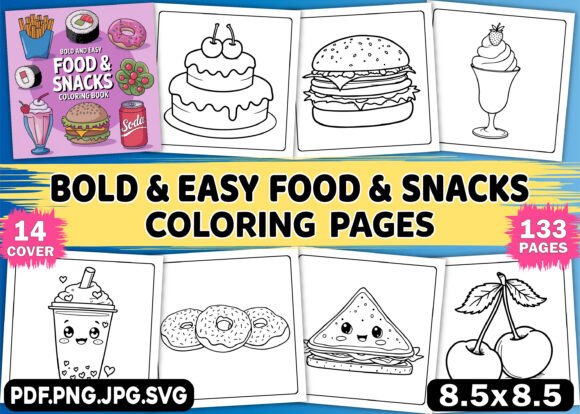
As someone who’s digitized hundreds of hand-drawn motifs for embroidery clients—from boutique aprons to baby onesies—I opened Bold Easy Food and Snacks Coloring Book expecting whimsy, not workflow potential. What stood out immediately wasn’t just the cheerful theme (think oversized donuts, chunky popcorn, smiling tacos), but the intentional simplicity: thick outlines, generous negative space, and zero fussy interior linework. This isn’t a coloring book pretending to be embroidery-ready—it’s a coloring book *designed* with stitch translation in mind. The A4 size (8.5” x 8.5”) gives breathing room for scaling down without losing legibility, and the 300 DPI resolution means crisp edges when converting to vector or tracing for digitizing.
A Real Project Test: That Custom Embroidered Kitchen Towel
Last week, I prepped a small-batch run of linen tea towels for a local café pop-up—each towel featured one food motif from Bold Easy Food and Snacks Coloring Book, stitched as a centered 3.5” design on the lower corner. I used the PNG files as base art, traced clean paths in my digitizing software, and kept fill stitches minimal—mostly satin-stitched outlines with light fill stitch on larger shapes like pizza slices. The result? Crisp, friendly, and unmistakably handmade. Customers didn’t just recognize the taco—they smiled, snapped photos, and asked if I’d do custom versions for birthdays. That kind of emotional resonance starts with smart source art, and this collection delivers it.
Where It Shines (and Where It Needs Thought)
Bold Easy Food and Snacks Coloring Book excels in projects where charm and clarity matter more than photorealism:
- Custom apparel: Works beautifully on sweatshirts and tote bags—thick outlines hold up well on textured fleece and canvas.
- Embroidered patches: Clean silhouettes translate cleanly into sew-on or iron-on patches; no tiny interior details to snag or blur.
- Baby items & nursery decor: Soft food themes (cupcakes, bananas, ice cream cones) feel warm and age-appropriate—no sharp angles or aggressive contrast to clash with gentle aesthetics.
- Holiday and gift stitching: Perfect for kitchen-themed Christmas stockings, personalized lunchboxes, or “first birthday” bibs—playful but not childish.
- Digital product previews: The JPG and PDF files render cleanly in printable mockups, helping Etsy sellers and craft fair vendors show realistic context before stitching.
Use With Intention—Not Assumption
This isn’t a plug-and-play machine embroidery design—it’s a *graphics* asset. That distinction matters. Before stitching, always:
- Test the motif on scrap fabric matching your final project (e.g., terry cloth for towels, lightweight cotton for baby caps).
- Check thread color contrast—bold outlines pop on dark fabric, but fine inner lines (if added during digitizing) may vanish without careful color planning.
- Review stitch density: the original coloring book art has no built-in stitch logic, so avoid overloading small areas like olive stems or waffle cone ridges with dense fill stitch.
- Confirm hoop size compatibility—some motifs scale beautifully to 4x4”, while others (like the full “snack platter” layout) are better suited for 5x7” or larger hoops.
- Inspect corners and curves—especially for caps or curved pillow covers—where distortion can stretch outlines or compress spacing.
What It Adds to Your Handmade Product—and What It Doesn’t
Used thoughtfully, Bold Easy Food and Snacks Coloring Book elevates perceived value. Customers connect food motifs with joy, comfort, and personality—making a simple embroidered tea towel feel like a curated gift, not just merchandise. It supports brand consistency for shops leaning into “kitchen lifestyle,” “foodie gifts,” or “whimsical home goods.” And because the art is bold and easy to read at a glance, it builds trust: buyers know exactly what they’re getting before it ships.
But let’s be clear—it won’t replace professional digitizing for complex applique designs or multi-layered satin-stitch work. There’s no built-in underlay, no jump stitch optimization, no thread path logic. You’re starting with strong raw material, not a finished embroidery file. That’s ideal for designers who enjoy shaping assets—but less so for beginners expecting drag-and-drop results.
Practical Designer Notes You’ll Actually Use
Before launching your next batch of embroidered snacks:
- Start with black-and-white mockups—it reveals how well outlines hold up without color distraction.
- Compare light vs. dark fabric backgrounds using the PNG files—some motifs (like the striped candy cane or polka-dot cupcake) gain extra charm on contrast, while others need subtle shadowing.
- Use tear-away stabilizer for stable fabrics (cotton, linen), cut-away for knits or stretchy blends—those bold outlines demand support to stay crisp.
- Verify commercial use rights—since this is listed under Kdp Interiors and Graphics, confirm licensing terms before selling finished embroidered products or reselling digitized versions.
- Pair with complementary fonts or borders—many motifs leave natural space for short phrases (“Snack Time”, “Yes Please”) without crowding.
Final Thought: A Reliable Spark, Not a Shortcut
Bold Easy Food and Snacks Coloring Book won’t automate your embroidery business—but it will reliably spark ideas, speed up concept development, and add warmth to products that need personality without pretension. Whether you’re stitching a single personalized baby bib or building a cohesive line of café-branded aprons, this collection earns its place in your design assets folder. It’s practical, expressive, and quietly versatile—exactly the kind of resource that makes handmade work feel both intentional and joyful.