Peacock Coloring Pages: Graphics for Kdp Interiors
As a graphic designer who’s built brand identities for handmade boutiques, seasonal Etsy collections, and print-on-demand product lines over the past 12 years, I recently evaluated Peacock Coloring Pages for a real client project: a spring launch for a small-batch botanical apothecary. The goal was to create cohesive packaging, social media graphics, and printable wall art that felt elegant yet approachable—whimsical without tipping into cliché. What stood out immediately wasn’t just the subject matter, but how the linework, scale, and intentional negative space translated across formats.
A Mood That Anchors, Not Distracts
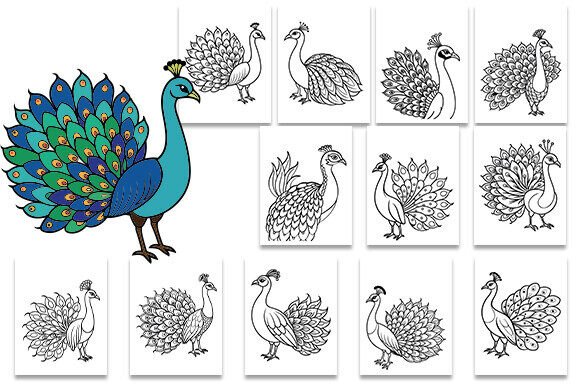
The 12-page set delivers a consistent visual rhythm—fluid contours, layered feather details, and balanced asymmetry that avoids rigidity. It reads as modern design with artisanal warmth: think hand-drawn precision elevated by digital refinement. Unlike generic clipart, these illustrations carry expressive weight—each peacock feels like a character, not a placeholder. That emotional resonance matters when designing for a handmade business where authenticity drives purchase decisions. For our apothecary client, it helped soften clinical herbal imagery while reinforcing themes of renewal and vibrancy.
Where Peacock Coloring Pages Earns Its Place in Real Projects
This isn’t a one-note asset—it flexes across commercial design contexts:
- Product mockups & packaging design: The high-resolution JPEGs (300 DPI, CMYK-ready) hold crisp detail on kraft boxes, linen labels, and matte-finish tins. I layered a simplified feather motif onto a tea box die-cut window—subtle, scalable, and instantly legible at 2” width.
- Social media graphics & Canva templates: SVG files scaled flawlessly for Instagram carousels and Pinterest pins. Paired with a clean sans serif (like Inter or Poppins), the illustrations added texture without competing with copy. Tested against light/dark backgrounds—no contrast issues.
- Cricut projects & sublimation design: Vector AI and SVG files retained anchor points cleanly. Used one full-page spread as a heat-transfer base for ceramic mugs—feather gradients printed richly, no banding or pixelation.
- Printable design & editorial design: PDFs opened reliably in Adobe Acrobat and Affinity Publisher. Printed on textured cotton paper for client gift tags—ink saturation remained even, no bleeding.
- Brand identity support: While not logo-ready as-is, key motifs (a single eye feather, abstract tail curve) were easily extracted and stylized into secondary brand elements—think watermark patterns, divider lines, or animated loading icons for their Shopify site.
Where Caution Applies—Not Every Project Fits
Peacock Coloring Pages shines in expressive, tactile, or nature-adjacent branding—but it’s not universally deployable. Avoid using it in:
- Minimalist corporate materials: The ornamental density can overwhelm clean layouts meant for tech SaaS or financial services.
- Small-scale applications: At under 16px height, fine linework blurs. Reserve for hero graphics, not favicon-sized icons or micro-printed QR code borders.
- High-contrast minimalist typography pairings: It competes with bold display fonts or tight script lettering. Works best with airy serifs (Cormorant Garamond) or friendly sans serifs (Lora, Montserrat Light).
- Crowded backgrounds: On busy patterned substrates (e.g., marble textures or dense watercolor washes), detail gets lost. Use on solid or gradient backgrounds only.
Designer Notes You Can’t Skip Before Client Use
Before dropping Peacock Coloring Pages into a live project, run these checks:
- Test black-and-white output: Print a grayscale version—does linework retain clarity? Some delicate interior strokes vanish; simplify where needed.
- Preview at actual size: Zoom to 100% in Illustrator—check anchor smoothness in SVG/AI files. One page had minor node redundancy; cleaned in 90 seconds.
- Validate commercial license scope: Confirm usage covers your client’s distribution model—especially for print-on-demand or digital resale (e.g., Canva template shops).
- Mockup realism: Drop assets into real product mockups (e.g., Spoonflower fabric swatches, Placeit tote bag renders). Does the scale feel intentional—not oversized or timid?
- Font compatibility sweep: Layer over common web fonts. It harmonizes with serif (Merriweather), sans (Open Sans), and script (Dancing Script)—but clashes with ultra-thin or geometric display fonts (Bebas Neue, Rajdhani).
- CMYK fidelity check: Soft-proof in Photoshop using SWOP v2. No unexpected color shifts—critical for branded packaging consistency.
Final Verdict: A Strategic Creative Asset, Not Just Clipart
Peacock Coloring Pages functions as more than decorative filler. It’s a creative design lever—adding narrative depth to an Etsy product listing, elevating the perceived value of a printable wall art bundle, or grounding a seasonal campaign in visual cohesion. For designers supporting small business branding, it bridges the gap between illustrative charm and production-ready utility. The inclusion of AI, PDF, SVG, and high-res JPEG ensures flexibility across workflows—from Cricut users cutting vinyl decals to marketers building Canva templates for clients. Just remember: its strength lies in intentionality. Deploy it where mood, texture, and organic elegance serve the brand story—not as visual noise. In the right context, it doesn’t just decorate. It communicates.