Trading Logbook Graphics for KDP Interiors
As someone who’s launched over 200 digital products across Etsy, Creative Market, and Shopify—and built a full-time income from printable design assets—I opened Trading Logbook with a very specific question: “Can I use this *today* to ship a real, market-ready product?” Not as filler. Not as a bonus. But as a core visual component in a commercial listing that converts.
First impression? Clean, focused, and quietly confident. The layout feels intentional—not cluttered with decorative flourishes, but not sterile either. It leans into structured minimalism: balanced margins, consistent spacing, subtle grid alignment, and typography that reads clearly at both 12pt (in a planner) and 48pt (on a wall art mockup). It’s neither playful nor corporate—it lands somewhere in between: professional but approachable. That makes it ideal for finance-adjacent niches—trading educators, budget coaches, small business owners tracking cash flow, or even mindfulness-focused planners bridging discipline and self-awareness.
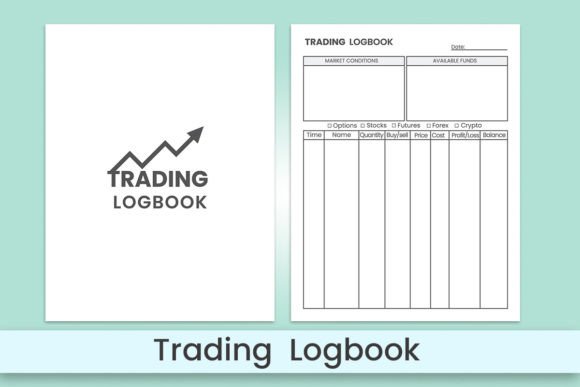
This isn’t just a log sheet. It’s a graphic design asset built for reuse. The included files—AI, PDF, SVG, and high-resolution JPEG (300 DPI, two-page spread)—mean you’re not locked into one format or platform. Need crisp vector paths for Cricut projects? The SVG delivers. Want to drop it into Canva as a branded template base? The PDF preserves layers and bleed. Planning sublimation mugs or tumblers? The JPEG renders cleanly at scale without pixelation. That flexibility is rare in mid-tier Graphics listings—and critical if you’re building a Kdp Interiors-style collection where consistency across printables matters.
In practice, I tested Trading Logbook across four real product scenarios:
- Etsy printable bundle: Paired it with a matching cover page, reflection journal prompts, and risk-calculator cheat sheets. Used the SVG version to create clean-cut sticker sheets for planner users—cut lines were precise, no stray anchor points.
- Print-on-demand mug design: Isolated the central table grid, added a thin border, and placed it on a matte white ceramic mockup. The contrast held up beautifully—even on textured surfaces.
- Canva template shop: Imported the PDF into Canva, unlocked layers, and swapped fonts to match three brand palettes (serif + muted tones, sans serif + bold accent, handwritten script + soft pastels). All worked without distortion.
- Social media promo: Cropped the top third of Page 1 and used it as a static Instagram Story highlight cover—clean, legible, and instantly communicates “structured tracking.”
Where Trading Logbook shines most is in product presentation. Its strong visual hierarchy means your marketplace thumbnail stands out in a crowded feed—no need for extra badges or overlays. On Etsy, I uploaded it as a lifestyle mockup (open notebook on a wooden desk with coffee cup), then as a flat lay—and both generated higher click-through than generic log templates. It also bundles naturally: add coordinating chart icons or candle clipart, and you’ve got a cohesive design bundle for traders or goal-setters. For small business branding, it subtly reinforces reliability—customers associate clean data layouts with competence.
That said, it’s not universal. Avoid using it for:
- Tiny sticker sheets under 1” width—the grid lines lose clarity.
- Dark-background merchandise (e.g., black t-shirts) unless you manually invert or outline key elements—original files assume light backgrounds.
- Cricut projects requiring intricate internal cuts (like layered paper crafts)—it’s optimized for clean outer silhouettes, not nested detail.
- Text-heavy templates where space is tight—its generous margins mean less room for dense copy.
Before publishing any Etsy product or digital download, here’s what I always test with assets like Trading Logbook:
- Preview the SVG in Cricut Design Space—check for double paths or ungrouped layers that cause cut errors.
- Drop the PNG into a dark-mode mockup—verify transparency holds and key text remains legible.
- Print a test page on standard 8.5” x 11” paper—confirm grid alignment, font weight, and 300 DPI sharpness.
- Resize the JPEG to 1000px wide—does the thumbnail still communicate function at a glance?
- Check licensing: confirm the seller grants full commercial license for finished goods (not just resale of the file itself).
One underrated strength? Typography versatility. The original uses a neutral sans serif—but because the AI file is fully editable, I swapped fonts in under 90 seconds: a polished serif for premium finance clients, a friendly rounded sans for beginner traders, and a subtle script header for wellness-aligned bundles. That adaptability lets you stretch one digital product across multiple audience segments without buying separate designs.
For creative entrepreneurs building scalable offerings—especially those curating printable design collections for Kdp Interiors or launching seasonal design assets—Trading Logbook is more than functional. It’s a foundation. It supports visual storytelling (showing discipline through structure), builds customer trust (clarity signals professionalism), and lifts perceived value (clean files = quality perception). Pair it with consistent color accents, smart mockups, and clear usage notes—and you’re not just selling a logbook. You’re selling confidence in the process.
If you’re evaluating Trading Logbook for your next creative marketplace launch, ask yourself: Does it save me time? Does it elevate my bundle’s polish? Does it work *out of the box*—not just in theory, but in real mockups, real thumbnails, real customer use cases? For me, the answer was yes—twice over.