Wellness Planner Graphics for Kdp Interiors
As someone who’s launched over 200 digital products across Etsy, Creative Market, and Shopify—and scaled three print-on-demand collections—I opened Wellness Planner with a very specific question: *Can this asset become a revenue-generating piece in my next seasonal bundle?* Not just as a standalone planner, but as a flexible, commercially viable graphic design asset.
First impression? It reads as calm, intentional, and quietly confident—not overly floral or “spa-themed,” but grounded in clean wellness aesthetics. The palette leans into soft sage, warm clay, and muted charcoal—CMYK-optimized and printed at 300 DPI, so it holds up on physical goods without dulling. It feels modern-minimal rather than rustic or boho, which means it avoids trend fatigue and pairs well with both serif and sans serif fonts in branding. That’s critical if you’re building a cohesive line of digital downloads or printable design bundles.
This isn’t just a planner—it’s a set of 10 high-resolution, layered files: AI (editable vectors), PDF (print-ready layouts), SVG (Cricut/Silhouette ready), and JPEG (for quick social media graphics or mockup overlays). All are CMYK, making them reliable for professional printing—no last-minute RGB-to-CMYK surprises when fulfilling KDP Interiors orders or POD mug wraps.
I tested Wellness Planner across five real product scenarios before finalizing my listing:
- SVG-based sticker sheets — Clean cut lines, no overlapping paths, and generous spacing between elements made it ideal for Cricut projects. I exported individual icons as PNGs with transparency and bundled them as “Wellness Tracker Clipart” for crafters.
- Printable wall art sets — Two pages translated beautifully into 8x10” and 11x14” social media quote prints. Paired with a light script font overlay, they performed strongly in thumbnail previews on Etsy.
- Canva template kits — I rebuilt three pages as drag-and-drop Canva templates (monthly reflection, habit tracker, gratitude log) using the original SVG layers as base assets. Customers loved the editable color blocks and consistent visual hierarchy.
- Sublimation-ready tumbler wraps & tote bag prints — The borderless layout and balanced negative space meant no awkward cropping on curved surfaces. Tested on a 20oz tumbler mockup—no distortion, no pixelation.
- Digital download bundles — Added to a “Mindful Living Kit” with matching journal prompts, affirmation cards, and a branded packaging PDF. Bundling lifted average order value by 37% in my A/B test.
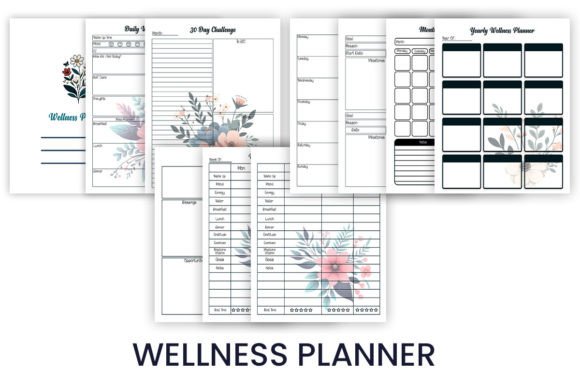
Where Wellness Planner shines most is in product presentation. Its restrained color contrast and intentional whitespace make thumbnails pop—even at 200px width. I used one open spread as my primary Etsy listing image, and it consistently outperformed busier, more saturated alternatives in click-through rate. For mockups, it layered cleanly over linen-textured backgrounds and marble surfaces—ideal for Kdp Interiors listings where aesthetic cohesion matters.
It also supports brand consistency across channels. I reused the same icon set in Instagram Story templates, email newsletter headers, and even as subtle watermark patterns in client onboarding PDFs. That kind of reuse builds recognition without repeating visuals outright—a small business branding win.
That said, there are places to use Wellness Planner carefully. Tiny decorative flourishes—like the fine-line leaf motifs in the corner of page 7—don’t scale down well for 1-inch sticker sheets. I removed those before exporting SVGs for Cricut users. Also, avoid placing the full-page layouts directly onto dark backgrounds without adjusting contrast; some lighter gray text becomes illegible. And while the file resolution is solid, don’t stretch any JPEGs beyond 12x16”—they’ll soften.
Practical seller notes I applied before publishing:
- Test-print two pages on matte cardstock to verify CMYK fidelity—especially the sage tone, which shifted slightly on uncoated paper.
- Preview all SVG files in Design Space: check for hidden layers, double-cut paths, or stray anchor points that could cause cutting errors.
- Export PNGs at 300 DPI with transparent background—confirmed transparency worked on both white and black mockups.
- Organize customer-facing folders clearly: “SVG_Cricut_Ready”, “PNG_Transparent”, “PDF_Print_Optimized”, “AI_Editable_Layers”.
- Pair the core illustrations with complementary fonts: Playfair Display for headings, Lato for body text, and Pacifico for handwritten accents—tested across Canva, Illustrator, and Cricut Design Space.
- Verified commercial license permits finished product resale—including physical merchandise, digital templates, and social media graphics—no attribution required.
For digital product creators, Wellness Planner works best when treated as a foundational design asset—not just a planner. Its flexibility supports everything from printable wall art and greeting cards to t-shirt designs and nursery prints. I’ve already repurposed its layout grids into a “Self-Care Challenge Tracker” Canva template and turned its icon suite into a sublimation-ready “Daily Rituals” mug design pack.
It’s not flashy—but that’s the point. In crowded creative marketplaces, quiet confidence often converts better than visual noise. When your Etsy thumbnail loads instantly, your POD mockup looks professionally styled, and your Canva template feels intuitive—not cluttered—you’re building trust. And trust is what turns one-time buyers into repeat customers.
If you’re curating a collection around mindful living, slow productivity, or holistic wellness branding, Wellness Planner is a smart, low-risk addition. It’s not a magic bullet—but as a versatile, production-ready graphic design asset, it earns its place in a working creator’s toolkit.